



China Work Visa: 90-Day Short-Term Work Permit
Foreign directors, cinematographers, photographers, models and film crew regularly travel to China for commercials, branded content, corporate films and photography campaigns.
But there is one question international producers often overlook:
Can foreign crew legally work on a short production in China without going through the full long-term work permit process?
In many cases, yes.
China has a specific short-term work permit system for foreigners working in China for up to 90 days. It can apply to film production, including advertising films and documentaries, as well as commercial photography and certain modelling assignments.
For overseas production companies bringing a director, DP, photographer or other crew into China for a short project, this can be much more practical than applying for a conventional long-term China Work Visa and work permit.
Importantly, this is not a new visa policy introduced in 2026. The short-term work framework has existed for years. What is less widely understood is that filming is specifically included within it.
Chinese regulations have expressly included “shooting films, including advertisements and documentaries” and activities such as print advertising shoots among qualifying short-term work assignments since the original short-term work procedures were introduced.

What Is the 90-Day Short-Term China Work Permit?
China separates foreign work assignments partly according to duration.
Foreigners planning to work in China for more than 90 days normally enter the standard long-term Foreigner’s Work Permit process.
For certain assignments lasting 90 days or less, however, a Chinese host company can apply for a:
Notification Letter of Foreigner’s Work Permit — Work in China for 90 Days or Less
Once approved, the foreign worker normally uses this notification to apply for a Z Visa, China’s work visa, before travelling to China.
Current Chinese government guidance specifically states that foreigners coming to China to work for 90 days or less should obtain a Foreigner’s Work Permit Notice and use it to apply for a Z Visa.
This makes the short-term route particularly relevant to international productions, where crew are usually travelling for one defined project rather than taking permanent employment in China.
Which Film and Photography Projects Can Qualify?
The official short-term work rules specifically include:
- filming, including advertising films and documentaries;
- print advertising shoots;
- fashion and modelling-related assignments;
- certain technical and management project work.
For production companies, this means the system can potentially be used for projects such as commercials, branded films, corporate productions, documentary shoots, product campaigns, fashion shoots and commercial photography.
Foreign personnel might include a director, cinematographer, photographer, production designer, lighting technician, camera technician, stylist or other crew member whose participation is required for the production.
The important point is that a short shoot is still work.
A three-day advertising shoot does not automatically become a business visit simply because the production is short.
Is a China Business Visa Enough for a Film Shoot?
This is probably the most important misunderstanding for overseas production companies.
A China business visa and permission to work in China are not the same thing.
An M Visa is designed primarily for commercial and trade activities. If a foreign crew member is actually performing professional work in China — directing, shooting, lighting, modelling or carrying out another production role — the production should determine whether work authorisation is required.
Current Chinese visa guidance categorises qualifying short-term work of up to 90 days under the Z Visa route when supported by a short-term Foreigner’s Work Permit Notice.
This is important even when the crew member is paid by an overseas company.
Where the salary is paid does not necessarily determine whether the activity itself constitutes work in China.
For an international commercial production, the safer question is therefore not:
“Can our crew enter China?”
but:
“Are they legally authorised to perform this work once they arrive?”
Who Applies for the Short-Term Work Permit?
The application is initiated in China.
A registered Chinese organisation acts as the host or engaging entity and submits the application through China’s foreigner work permit system.
Depending on the structure of the production, this may be a Chinese production company, production service company, advertising company, media company or another appropriate local entity involved in the project.
The Chinese applicant provides the project information and takes responsibility for the accuracy of the application.
For international producers, this is one of the reasons it is useful to establish the Chinese production structure early, rather than waiting until flights and crew dates have already been confirmed.
What Documents Are Normally Required?
One of the main advantages of the short-term system is that the national application requirements are considerably lighter than the conventional long-term work permit process.
The standard application normally centres around the foreigner’s passport, the work permit application form and documentation explaining the relationship between the foreign worker and the Chinese project.
This can include a project contract, cooperation agreement, work agreement or invitation document.
The documentation should clearly explain who the applicant is, what work they will perform, where they will work and the period during which the work will take place.
Official work permit guidance also requires short-term applicants to declare their work locations and expected entries into China. Multiple workplaces can be declared in the application. Jinan Government
If the activity itself requires approval from another Chinese industry regulator, the corresponding approval document may also be required.
Do Short-Term Film Crew Need Degree Certificates and Police Checks?
This is one of the biggest practical differences between a short-term project and a conventional long-term foreign employment application.
A normal long-term China Work Permit can involve documents such as qualification certificates, evidence of professional experience, criminal-record documentation and medical examinations.
The national application checklist for a 90-day-or-less work permit is much simpler.
The core short-term checklist does not contain the same standard requirement for authenticated university degrees, overseas police-clearance certificates and medical examination documents that applies to many conventional long-term applications. Jinan Government
This can make a major difference for a commercial production bringing international crew members into China for only a few days or weeks.
However, this should not be interpreted as meaning that authorities can never ask for additional documents.
The exact requirements can vary according to the applicant, nationality, city, role and nature of the project. Professional CVs, credits or evidence of relevant experience may therefore still be useful when preparing an application.
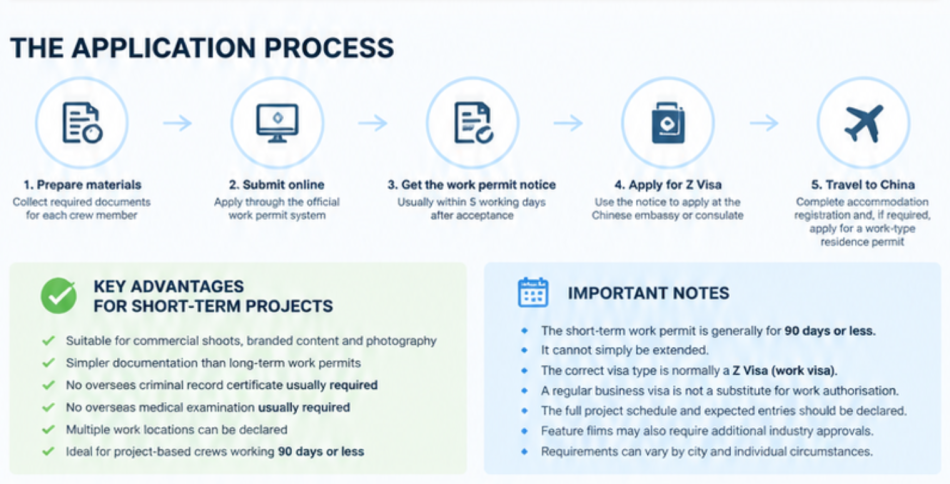
How Does the Process Work?
For most productions, the process begins before the foreign crew member travels to China.
The Chinese project partner first prepares and submits the short-term work permit application.
Once approved, the foreign crew member receives the electronic Notification Letter of Foreigner’s Work Permit for Work in China for 90 Days or Less.
The applicant then uses the notification and other required documents to apply for the appropriate Z Visa through the Chinese embassy, consulate or visa application centre responsible for their application.
Current government service guidance normally gives the decision-making authority around five working days after formal acceptance for a short-term work permit application, although preparation, preliminary review, visa processing and any additional document requests must be allowed for separately. Beijing Health Service Center
For film production, we would therefore never recommend treating this as a last-minute visa process.
The earlier the crew list and production dates are confirmed, the better.
What Happens After the Crew Arrive in China?
The next step depends largely on the authorised length of the stay.
Residence formalities depend on the authorised stay and the conditions recorded on the visa and work permit documents. Confirm the required steps before the crew travel.
For longer short-term assignments, a work-type residence permit is generally required after arrival.
The Hunan government guide describes a residence-permit exemption for Z Visa holders staying less than 30 days, and additional residence formalities for stays of 30 days or more. Check the exact threshold and local requirements with the issuing authority, particularly for a stay of exactly 30 days. Hunan Province Government
Foreign crew must also comply with China’s normal accommodation registration requirements after arrival.
For crews staying in hotels, this is normally handled by the hotel. Different arrangements may apply when crew are staying in private accommodation or serviced apartments.
Can a 90-Day Work Permit Be Extended?
This is where production planning becomes particularly important.
A short-term work authorisation should not be treated as an open-ended work permit.
Official work permit guidance states that foreigners approved to work in China for 90 days or less must work within the approved period and that the short-term authorisation itself cannot simply be extended. Jinan Government
So if a commercial was originally expected to require six weeks in China but gradually develops into a four-month assignment, the producer should not assume that the crew can simply extend the existing permit.
A different work permit structure may be required.
There are circumstances in which a foreigner already legally present in China under a short-term work authorisation may qualify to apply for a longer-term work permit, but this is a separate application and depends on the individual’s circumstances and the local authority.
It should not be treated as an automatic extension.
Does Leaving China Reset the 90 Days?
No production should plan on this assumption.
International shoots are often divided into several phases. A director might work in Shanghai for several weeks, return to Europe and come back later for another phase of the same campaign.
The short-term work application records the approved work period and also allows expected entries into China to be declared.
Leaving China therefore should not be treated as an automatic way to start a fresh 90-day allowance.
If the same production is expected to involve several visits, the entire schedule should be considered when the application is prepared.
A genuinely separate production with a different contract and project structure may be assessed separately, but one continuous project should not simply be divided on paper in order to avoid the applicable work permit requirements.
Can the Crew Work in More Than One City?
Yes, this can be possible.
This is particularly useful for commercial productions that might shoot a studio day in Shanghai, a factory in Suzhou and another location elsewhere in China.
Current short-term work permit guidance allows multiple work locations — and even multiple employing entities in certain circumstances — to be declared in the application. All relevant work locations should therefore be identified when preparing the project paperwork. Hunan Province Government
For production managers, this means it is useful to have at least a preliminary shooting schedule before starting the visa process.
A significant change in crew role, location or production structure should be checked before simply assuming that the original authorisation covers the new work.
What About Feature Films?
This is an important distinction.
The China Work Visa and work permit relate to the foreign individual’s permission to work.
They do not automatically give a foreign production permission to make any type of film in China.
Feature films and some other regulated audiovisual productions can involve additional approval from the relevant Chinese film or industry authorities.
Chinese work permit guidance specifically states that where an occupation or activity requires pre-approval from an industry authority, the appropriate approval document must also be provided. Jinan Government
For this reason, there are two separate questions when an international feature film comes to China:
Can the foreign crew legally work in China?
and
Does the production itself have the necessary permission to film in China?
A short-term work permit solves the first question. It does not automatically solve the second.
Commercial advertising, branded content and corporate production will often have a simpler regulatory structure than an international theatrical feature film.
What About Models and Commercial Photography?
Commercial photography is particularly relevant to this system.
China’s short-term work rules specifically mention activities such as print advertising shoots within the short-term framework. Human Resources Ministry
This means an overseas fashion or advertising production should not assume that a photographer, stylist or model can simply enter China as a tourist or ordinary business visitor because the shoot lasts only one or two days.
The duration of the job is only one part of the question.
The nature of the activity matters.
There is also an important distinction between commercial photography/modelling and a commercial stage performance. Commercial performances can fall under a different approval procedure involving China’s cultural authorities.
For unusual productions, this distinction should be checked before applications are submitted.
Short-Term Work Permit vs Long-Term China Work Permit
The simplest way to think about the difference is the production schedule.
A foreign DP coming to China for a ten-day commercial is very different from a cinematographer relocating to China for a six-month production.
For a qualifying short production of 90 days or less, the short-term work permit route may provide a much more efficient solution.
For work extending beyond 90 days, the normal long-term Foreigner’s Work Permit system generally becomes relevant, with more extensive qualification and documentation requirements.
The production should therefore decide the immigration structure before dividing crew into travel blocks.
For a larger project, it is entirely possible that different crew members need different solutions.
A director might be in China for 18 days.
A photographer may come for five days.
The production designer might remain for eight weeks.
A senior department head might be required for four months.
There is no reason to assume that every international crew member must necessarily follow the same immigration route.
Planning Work Permits for a Large International Crew
For a production bringing 10, 20 or 50 foreign crew members to China, the first step should not be completing visa forms.
It should be building a clear crew immigration matrix.
At minimum, the production should establish:
Crew Member | Nationality | Role | Arrival | Departure | Work Dates | Work Locations
Once this information is available, the Chinese production partner can separate personnel who may qualify for the 90-day short-term route from those who may require a longer-term work permit or additional industry approval.
This is considerably easier than trying to solve immigration problems individually after dozens of flights have already been booked.
It is also particularly important for productions involving crew from several countries, as the final visa application procedure can differ between Chinese embassies and visa centres.
Do You Need a China Work Visa for Your Shoot?
If foreign crew will actually perform professional work during a production in China, the visa and work permit structure should be considered during pre-production — not at immigration after the crew lands.
For many commercials, branded productions, documentaries and photography campaigns lasting less than 90 days, China’s short-term work permit system provides a legitimate route for international crew.
The important points are relatively simple:
The Chinese project structure should be established first.
The crew member’s actual role and working dates should be declared accurately.
The work permit should be obtained before the corresponding work visa application.
And the production should not confuse permission to enter China with permission to work in China.
Film Production Support in China
Shoot In China has supported international productions across China since 2012.
Alongside bilingual production support, location scouting, production fixers, local crew, equipment rental and filming logistics, we can help international producers prepare and coordinate the information required when foreign production personnel need to work legally in China.
For larger productions, we can review a preliminary crew list and production schedule to help identify which personnel may fall under the short-term work permit route and which cases require further review.
If you are planning a commercial, branded film, documentary or photography production in China, send us the crew roles, nationalities, expected working dates and filming locations at the beginning of pre-production.
It is much easier to build the right China Work Visa strategy before the crew book their flights.